PyTASER Materials Project Example Workflow#
The following examples use data from the (legacy) Materials Project database to generate the predicted transient absorption spectra under various conditions. Note: This will require an API key that can be acquired from https://legacy.materialsproject.org/janrain/loginpage/?next=/. This key can then be added to your .pmgrc.yaml file as below to prevent the need to repeatedly enter it:
pmg config --add PMG_MAPI_KEY <YOUR_API_KEY>
Setup#
[1]:
%matplotlib inline
import numpy as np

from pytaser.kpoints import get_kpoint_weights
from pytaser.generator import TASGenerator
from pytaser.tas import Tas
GaAs#
[2]:
from pymatgen.ext.matproj import MPRester
from pymatgen.ext.matproj import TaskType
from pymatgen.electronic_structure.plotter import BSPlotter
mpr = MPRester()
bs = mpr.get_bandstructure_by_material_id("mp-2534")

from pymatgen.electronic_structure.plotter import BSPlotter
plt = BSPlotter(bs).get_plot(vbm_cbm_marker=True,ylim=[-3,+3])
/Users/savyaaggarwal/opt/anaconda3/envs/pytaser/lib/python3.9/site-packages/pymatgen/ext/matproj.py:185: UserWarning: You are using the legacy MPRester. This version of the MPRester will no longer be updated. To access the latest data with the new MPRester, obtain a new API key from https://materialsproject.org/api and consult the docs at https://docs.materialsproject.org/ for more information.
  warnings.warn(
[3]:
bs.get_band_gap()
[3]:
{'direct': True, 'energy': 0.1839000000000004, 'transition': '\\Gamma-\\Gamma'}
As shown from the above bandstructure, the MP database often underestimates material bandgaps. The experimental direct bandgap for GaAs is actually observed to be 1.5 eV. This arises due to the use of semi-local exchange correlation (GGA) functionals in their calculations - to correct for this, we must apply a scissors operator and increase the bandgap to that of the inputted experimental bandgap.
[4]:
generator_2534 = TASGenerator.from_mpid("mp-2534", bg=1.5)
The from_mpid method generates a TASGenerator object using the bandstructure and DOS objects imported from the MP database. As we have defined the bg argument as the experimental bandgap, the bandstructure and DOS objects are scissored accordingly, as can be seen in the below cell. Additionally, this method generates kpoint-weightings for the inputted material, as long as it uses a uniform-mode kgrid for its bandstructure.
[5]:
generator_2534.bs.get_band_gap()
[5]:
{'direct': True,
 'energy': 1.5,
 'transition': '(0.000,0.000,0.000)-(0.000,0.000,0.000)'}
[6]:
tas_2534 = generator_2534.generate_tas(temp=298,
                                      conc=1e18, #inversely proportional to time delay
                                      energy_min=0.5,
                                      energy_max=5)
#generating the occupancies of each band using the Fermi-Dirac approx. implemented in pymatgen.
#externally generated occupancies can also be inputted if required.
The spectra can take a while to generate, depending on the number of bands and kpoints we are considering in the system. To save time during the (re-)analysis, it’s generally best practice to save our generated TAS object to a json file.
[7]:
from monty.serialization import dumpfn
dumpfn(tas_2534, "GaAs/tas_2534.json")
When we want to redo some of this analysis, in this notebook or a new one, we can load the TAS object from the json file, without having to re-generate the data.
[8]:
from monty.serialization import loadfn
tas_2534 = loadfn("GaAs/tas_2534.json")
Let’s plot the predicted TAS spectrum for this material, under the conditions we specified above:
[9]:
from pytaser.plotter import TASPlotter

plot_2534 = TASPlotter(tas_2534, material_name="GaAs")
energy_plot = plot_2534.get_plot(
    xaxis="energy", transition_cutoff=0.01, xmin=0.5, xmax=4, yaxis="jdos_diff")
# Reverse axis for better comparison to experiment
energy_plot.gca().invert_xaxis()

Without the WAVEDER files used in the PyTASER DFT Example, the TAS spectra we calculate does not consider oscillator strengths - it is just the change in joint density of states. Thus, the yaxis argument is set to jdos_diff. We can also plot the spectra as a function of wavelength, by setting xaxis="wavelength" (and adjusting the xmin and xmax respectively)
[10]:
from pytaser.plotter import TASPlotter

plot_2534 = TASPlotter(tas_2534, material_name="GaAs")
energy_plot = plot_2534.get_plot(
    xaxis="wavelength", transition_cutoff=0.01, xmin=400, xmax=1400, yaxis="jdos_diff")
# Reverse axis for better comparison to experiment
energy_plot.gca().invert_xaxis()
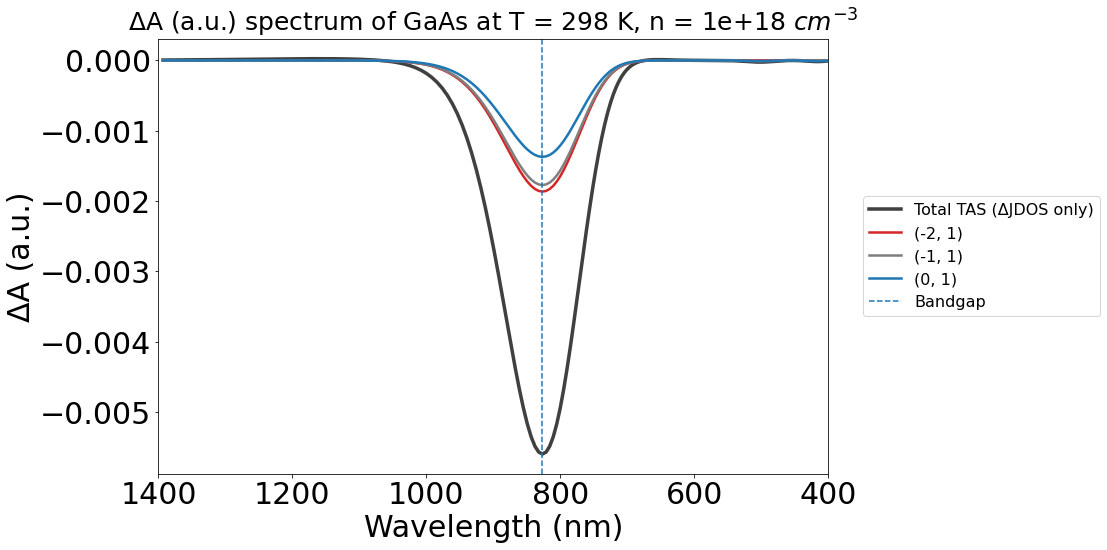
Another plotting option is to plot the individual JDOS spectra - to show the JDOS in the dark and under illumination separately. This will show the optically linked electronic states in their respective light conditions.
[11]:
from pytaser.plotter import TASPlotter

plot_2534 = TASPlotter(tas_2534, material_name="GaAs")
energy_plot = plot_2534.get_plot(
    xaxis="energy", transition_cutoff=0.01, xmin=0.5, xmax=4, yaxis="jdos")
# Reverse axis for better comparison to experiment
energy_plot.gca().invert_xaxis()
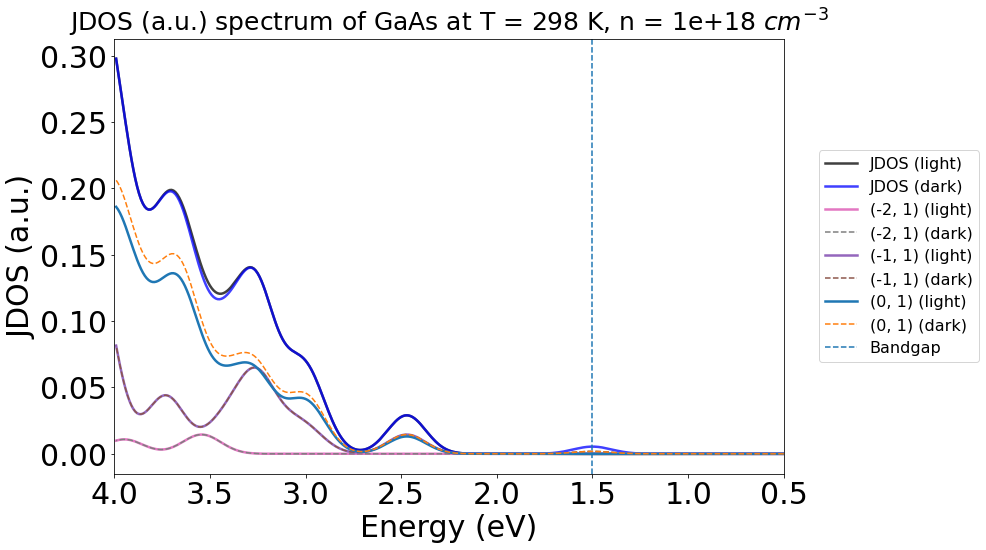
Here, we see notable differences between the dark (blue) and light (black) plots at ~3.5 eV and ~1.5 eV, matching with the peaks we see in the earlier energy TAS plot.
A significant advantage of predictive spectra is the ability to vary the system conditions. In PyTASER, the two main conditions we can change are the temperature of the system and the pump-probe time delay, which will both influence the occupancies of the bands based on the Fermi-Dirac approximation.
This is achieved by altering the conc and temp tags in the generate_tas method. We use the conc as an analogy of the pump-probe time delay, as the carrier concentration is inversely proportional to the time delay between initial excitation and absorption measurement.
Note: At the moment, conc can only be qualitatively compared to the time delay - to make a quantitative comparison, we need to consider carrier recombination rates, which would differ with each system. Thus, this functionality should be used more to understand the origin of different spectral features, rather than to provide a full, quantitative comparison.
[12]:
from monty.serialization import loadfn
conc_xydata = loadfn("GaAs/conc_xydata.json")

colors = ['green', 'blue', 'orange', 'red', 'purple']
labels = ["1e16", "1e18", "1e19", "1e20", "bandgap"]
plt.figure(figsize=(12, 8))

for i, data in enumerate(conc_xydata):
    x = data[:, 0]
    y = data[:, 1]

    if labels[i] == "bandgap":
        # Plot the "bandgap" line as dashed
        plt.plot(x, y, color=colors[i], linestyle='--', label=labels[i], alpha=0.5)
    else:
        plt.plot(x, y, color=colors[i], label=labels[i], alpha=0.8)

plt.xlabel('$\lambda$ (nm)', fontsize=30)
plt.ylabel('ΔA', fontsize=30)
plt.title('GaAs TAS Spectra with varying carrier concentrations', fontsize=30)
plt.grid(False)
plt.xticks(fontsize=30)
plt.yticks(fontsize=30)
plt.legend(
    loc=("center left"),
    bbox_to_anchor=(1.04, 0.5),
    fontsize=(16))
plt.show()

Similarly, this can be done with varying temperatures.
Note: Due to limitations of the pymatgen FD approximation method used during the band occupancy generation stage, PyTASER cannot calculate system occupancies at 0 K. It may also struggle with other lower temperatures, but this is dependent on the bandgap of the sytem - usually anything above 25 K is fine.
[13]:
from monty.serialization import loadfn
temp_xydata = loadfn("GaAs/temp_xydata.json")

colors = ['red', 'orange', 'blue', 'green', 'purple']
labels = ["50K","150K", "300K", "450K", "bandgap"]
plt.figure(figsize=(12, 8))

for i, data in enumerate(temp_xydata):
    x = data[:, 0]
    y = data[:, 1]

    if labels[i] == "bandgap":
        # Plot the "bandgap" line as dashed
        plt.plot(x, y, color=colors[i], linestyle='--', label=labels[i], alpha=0.5)
    else:
        plt.plot(x, y, color=colors[i], label=labels[i], alpha=0.8)

plt.xlabel('$\lambda$ (nm)', fontsize=30)
plt.ylabel('ΔA', fontsize=30)
plt.title('GaAs TAS Spectra with varying system temperatures', fontsize=30)
plt.grid(False)
plt.xticks(fontsize=30)
plt.yticks(fontsize=30)
plt.legend(
    loc=("center left"),
    bbox_to_anchor=(1.04, 0.5),
    fontsize=(16))
plt.show()
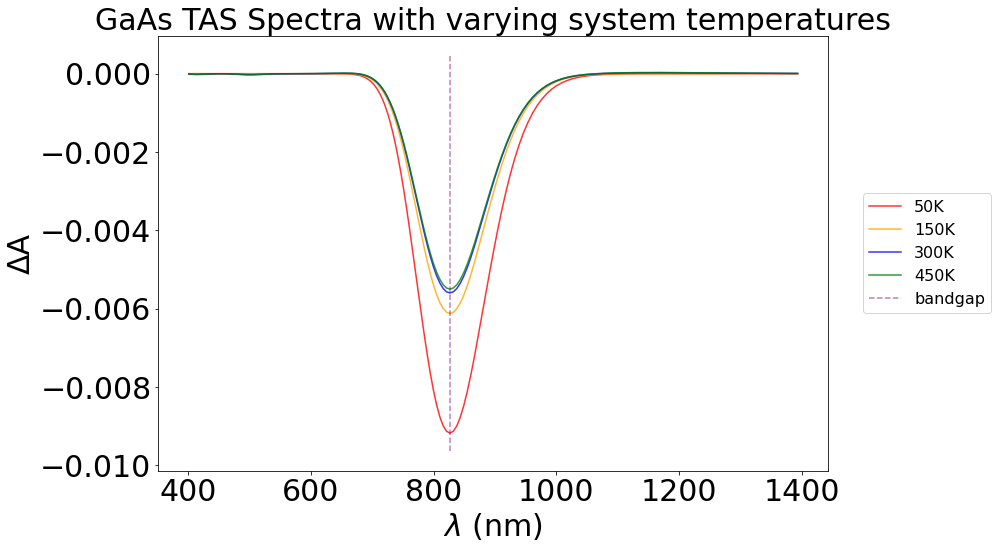
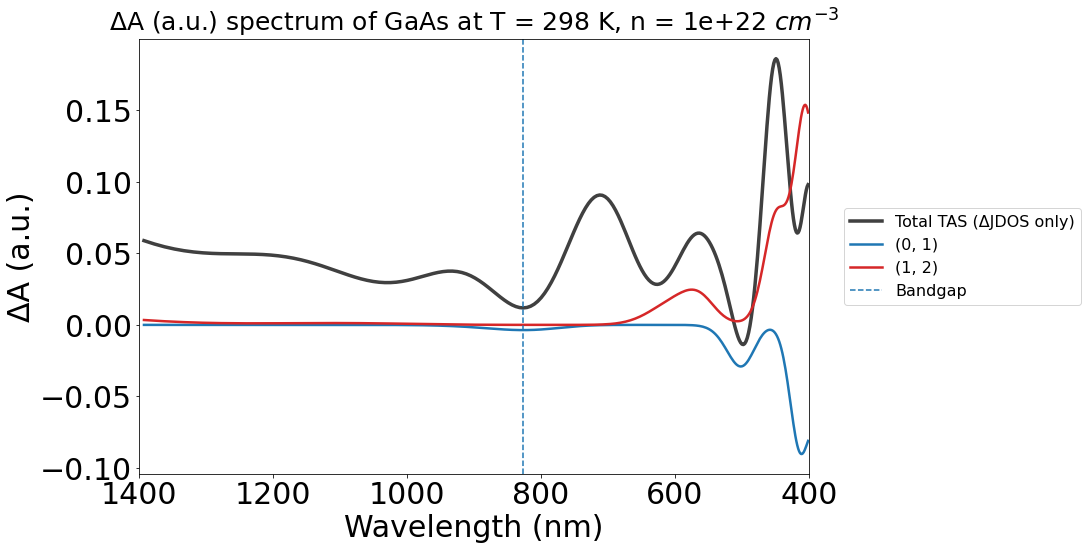
With the above plot, we can observe a higher dip in the ΔA plot as we decrease temperature, in the bandgap region. At higher temperatures, electrons are thermally excited from the VBM, causing a lower change in absorption between the dark (just thermal excitation) and the light (thermal + photo excitation) - thus, a smaller overall change in the TAS spectrum at the bandgap. However, since a small number of carriers are already in their excited state at higher temperatures, we also see changes in regions away from the bandgap. This is hard to see in this system, but we can see small fluctutations between temperatures around the 500 nm and 1100 nm marks.
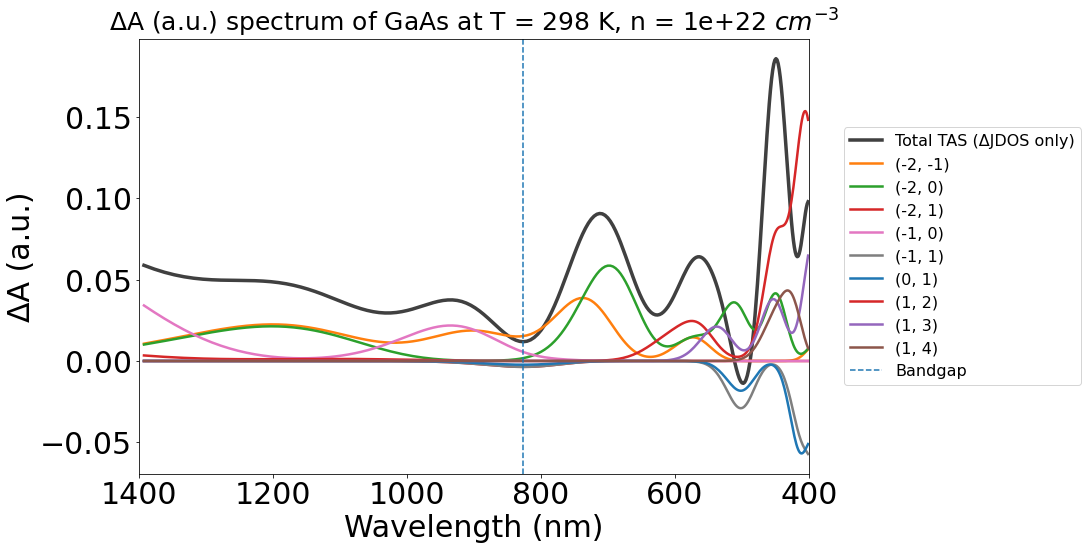
A key advantage of PyTASER’s functionality is the ability to visualise individual the contribution of individual band transition to the overall spectrum, whether JDOS or TAS. These individual transition contributions can be very useful to highlight specific spectral features in the overall spectra. This can be a big time-saver for quick analysis, as the numerically accurate method uses a series of complicated Fourier transforms to isolate these contributions. Note: The likelihood of each band transition happening is linked to the transition probability (and thus the oscillator strength, as used in the DFT example). This is not possible to include here, due to limitations in the MP database, so the overall spectrum may differ qualitatively to experimental spectra, especially those with long recombination times!
We can adjust the contribution threshold transition cutoff of the plots to get rid of less important transitions. The maximum of this is 1.0, which will show the largest contributing transition only.
[14]:
conc_22 = loadfn("GaAs/gaas_conc_22.json")
plot_22 = TASPlotter(conc_22, material_name="GaAs")
energy_plot_22 = plot_22.get_plot(
    xaxis="wavelength", transition_cutoff=0.01, xmin=400, xmax=1400, yaxis="jdos_diff")
# Reverse axis for better comparison to experiment
energy_plot_22.gca().invert_xaxis()
[15]:
energy_plot_22 = plot_22.get_plot(
    xaxis="wavelength", transition_cutoff=0.5, xmin=400, xmax=1400, yaxis="jdos_diff")
# Reverse axis for better comparison to experiment
energy_plot_22.gca().invert_xaxis()